Posted on

True Ames FIN TALK with Chuck Ames

Welcome to “Fin Talks” – a series of interviews with the most talented and respected surfer/shapers in our industry. In these interviews, we will explore a wide range of topics related to fin design, performance, and history. We hope you enjoy this series and the insight each discussion brings.

For our first edition, who better to sit down with than True Ames Owner and legendary craftsman, Chuck Ames. Beginning in 1979, Chuck has been fine tuning surf fins for the world’s best surfers across all disciplines. From classic noserider single fins to performance thrusters, each fin is precision foiled for optimal performance.

In our discussion with Chuck, we covered the importance of flex and how it plays a role in performance surfing. We also learned about the evolution of materials from the first fins Chuck foiled, to what is used today to create the industry’s best fins. Lastly, we looked at the history of the L-Flex and the collaboration between Greg Liddle and Chuck in designing the template.

Lets get into it…

TA: Why is flex important in fin design?

CA: Simply stated: flex allows one to make smooth transitions while in a turn. Flex allows the board to release and transition to the rail while maintaining speed and control…and even acceleration! A rigid fin can “spin out” when loaded up in a turn and will not have a smooth transition. Conversely and overly flexible fin will lose drive in the turn and will not produce the power needed to set up for the next turn.

Proper flex is dictated by the particular fin design. Many fins can benefit from flex!

George Greenough at Honolua Bay. Shot by John Witzig, 1967 – retrieved from icecreamheadaches.nyc

TA: What type of fins benefit the most from more/less flex?

CA: The fins that benefit the most from flex are in the area of performance surfing! There are many shapes and sizes of fins from single fins to multi fin surfboards.

One of the most popular fins that benefit from flex (and a proper foil) is the Greenough 4A. This design originates with inspiration from a Tuna fish. These fish travel at high speeds and can make rapid direction changes. It is very evident that their fins flex from the mid-section to the tip. So we attempt to emulate this with our fins and especially with the 4A!

Narrow, high aspect ratio, fins must have just the right flex characteristics if they are to perform at a high level. These kinds of fins certainly benefit the most from “proper” flex.

A fuller area, pivot style fin, such as a Yater spoon does not depend on flex for it to perform well. Mostly because the kind of surfing typically done is not rail to rail.

TA: What about the L-flex? Can you elaborate on some of the history of that fin? How did you and Greg Liddle initially team up?

CA: A “Liddle ” about the L-Flex. The origin of the L-Flex is certainly with Greg Liddle and his “hull design” surf craft. But to go back a bit further one could point to the defining moment when Nat young won the world contest in 1966. Magic Sam was the name of his modified/shortened self shaped pig. The fin was not working too well, and just before the contest George Greenough actually took a bunch of area out of Nat’s fin and gave it “proper” flex. He went on to win that contest and some say that was the beginning of the shortboard revolution. The important takeaway is that Nat was riding a “hull” style board and a narrow fin with flex made this board come alive

Fast forward to 1979 when I first started to foil fins for Greg Liddle: Greg was one of my first customers and showed me how to properly foil one of his L-flex designs using heavy Volan fiberglass material. The fins were crude (by today’s standards) but the foil/flex/design were the driving factors to make his hull design surfboards come alive! There were so many templates! Each board design dictated a specific fin. These fins have become a timeless staple that most surfers have benefited from.

TA: Volan fins are known to be the highest quality fins on the market, how does Volan impact flex and performance characteristics?

CA: Volan fiberglass has been the material of choice for pure flex fins from the late 60’s . It is basically an industrial boat fabric. For some reason, (that has never been fully explained to me ), Volan exhibits great flex properties when used to make a fin using polyester resin (*). Volan fins flex further down into the body of the fin making for a nice evenly distributed flex. This is probably the most notable characteristic of the Volan fiberglass when used to make a flex fin. We also try to strategically “orient” the fiberglass weave to optimize flex/twist as well.

*fins made with common surfboard “E” glass tend to be stiffer in the middle of the body. They only have tip flex.

Posted on

True Ames Fin Talk  – Malcolm Campbell

What’s in a name?  Well, if the name is Campbell and we are talking surfboards, then half a century of design theory, innovation, and style.  Malcolm and Duncan Campbell have spent the last 50 years developing, riding, and refining some of the most uniquely functional surf craft ever made.

It started with an idea in 1970, and it has grown into a global movement that is hard to explain to those uninitiated to the Bonzer tribe. The Campbell Bros. and True Ames have worked together since the early days, so we thought it fitting to talk fins with Malcolm Campbell, and pick his brain as to how and why the Bonzer board and fin set up has worked so well for so long.

TA: For those who might not know, when did you begin collaborating with True Ames to manufacture Bonzer runners and center fins for your boards?

MC: We have been working with True Ames fins for over 4 decades. Beginning in the days when Chuck Ames was a solo act, to now – as one of the top fin companies on the planet. Chuck has always been an integral part of the Campbell Brothers Bonzer Experience.

TA: What was the catalyst that inspired the Bonzer design? What would you attribute its longevity to?

MC: The catalyst for our development of the Bonzer design was the Shortboard Revolution of the late 1960’s. Board lengths dropped drastically over a short period of time. Duncan and I were heavily influenced by what was going on in Australia at the time. Many of the boards were in the low six foot range and below. We were totally on board with the small boards, but were finding that their range of versatility was lacking. We were interested in riding very short boards but realized that the boards needed more drive and stability than what the existing twin and single fins provided. Long story short; in 1970 – Duncan, my father, and I did some brainstorming and came up with the 3 Fin Bonzer in December of that year. It incorporated two long keel shaped side fins placed forward of an eight inch center fin. The deep center fin was due to the wide tail of this template. The initial testing proved to be a revelation and our mission had begun.

TA: How do the performance aspects of a Bonzer 5 and Bonzer 3 differ? On the other hand, are there important similarities that cross-over between them?

MC: There are different performance characteristics between the 3 and 5 fin Bonzer fin systems, but it is not a simple case of one being superior to the other. The hydrodynamic principal is the same for each. Therefor the speed, drive, edge control, rail to rail transition and maneuverability are present in both the 3 and 5 fin setups. The differences present themselves in various ways depending on what template they are utilized on. It is a bit tedious to go through, but basically the five fin employs more fin area closer to the rail further up on the board. This provides a bit more hold and edge control in deep critical areas of the wave. Depending on the width of the tail this aspect will be more or less apparent. To be honest we haven’t done a one to one comparison on each of our models. A couple of years ago I shaped Taylor Knox identical (as much as possible) 5’11’’ Wi 5 models, one 3 fin and one 5 fin version. Taylor has been riding Bonzer 5’s periodically for 23 years. He knows them well. This was his first experience riding a Bonzer 3 shaped the same as his Bonzer 5’s. He really enjoyed giving the 3 fin a go. The two things he liked most were the high lines he could draw through critical sections backside and the drive he could initiate coming down the face after carving off the top. This was the case both frontside and backside. In final analysis though, he said that if he were to ride one in a contest he would choose the 5 fin. The Bonzer 5 is a bit quicker off the mark and just suits the modern shortboard style of surfing for this type of template shape. Over the years we have created a general pairing of the 3 and 5 fin systems with particular shapes in our range of boards, but this does not preclude mixing and matching according to a customer’s wish.

TA: Do you have a formula for people to use when sizing a center fin for their Bonzer?

MC: As a general rule we recommend larger fins for wider tailed and longer boards. ‘General’ is the operative word though; because the size of the person as well as their personal preference also has a barring on center fin size. Sometimes a bit of experimentation is in order to arrive at the optimum combination.


TA:
 We are all huge fans of your curated music selection. Is there any specific genre that gets you excited to shape and surf? What other forms of art are you inspired by?

MC: The curated music within the Bonzer online universe is provided by my son Jacob. He has a deep awareness of musical roots and he keeps dear ole dad and uncle Duncan up to date as to what shines these days. Jacob has also picked up the Bonzer shaping mantel and is keeping us on our toes there as well. Visual art, photography, film, literature, philosophy and music have all played a part in making us who we are. Music was the predominant driving force for us in the early Bonzer years. The Kinks, Capitan Beefheart, Lou Reed, David Bowie, John Cale, Brian Eno and Roxy Music, to name a few, gave us energy
and inspiration to push ahead as outsiders in the surfboard design world.
We have been asked what we attribute the Bonzer’s longevity too? Plain and simple, they work really freaking well. Bonzer is Australian slang for extra ordinary or unique. Our 52 year Bonzer Experience has been nothing short of that.

Posted on

THE RIGHT SURFBOARD LEASH

Having worked in a Surf Shop for many years, these are very familiar questions.

Why do I need a leash?What size leash should I get?
What is the difference between all these leashes?
How thick should my leash be?How do I attach it to my board?

The modern surfboard leash was developed in California in the early 1970’s. The first leashes were made of surgical tubing with a suction cup that was placed on the nose and a strap placed on your wrist. We figured out pretty quickly that this really wasn’t the best idea (it’s pretty hard to paddle with a leash attached to your wrist)!

Next came the bungie cord with a leather strap that attached to your ankle. This worked out much better, except that when you lost your board and the cord stretched out, the board came rocketing back at you, warp speed!

The modern leash is a greatly advanced device, a solid urethane cord, attached to a padded cuff and railsaver with swivels to prevent tangling.Leashes help keep you attached to your surfboard. Your leash allows you to fall on a wave, or bail your board when you’re in a difficult position in the impact zone. After you surface, you are then able to recover your board and get back out into the line-up. Without a leash you’re forced to swim and retrieve your board wherever it ends up. Most times, your board ends up on the beach or on the rocks. Besides the inconvenience of having to swim for your board, and the loss of time when you could be riding waves, losing your board can also be dangerous to other swimmers and surfers.

Leashes are NOT a safety device! They were designed for convenience…… words of warning……. You are in the Ocean, there is no substitute for good swimming ability. If you look at the waves and don’t feel confident to swim alone without your surfboard, DON’T GO OUT!

Another good reason to use a leash – Performance. In almost all conditions, falling off your board or losing your board is a pretty common part of any session. Your leash allows for quick recovery of your board. The quicker you get back on your board, the quicker you get back out and get another wave.Reefs are also a pretty good reason to wear a leash. Reefs are often very shallow, very sharp and dangerous. Often, the only thing that separates your flesh from razor sharp reef is your board. You really don’t want to lose your board under these circumstances. Not only will you get all torn up, but expect the same or worse for your board.

OK, you realize the value of a leash. How do you grab the right one for you? The basic formula to stick to, is to make sure that the leash is at least the length of your board. The less experience you have, the longer your leash should be. If you’re riding a 7 foot board and still learning to control it, then make sure your leash is at least a foot longer then your board. Keep in mind that most leashes are really about 6 inches longer then the sizes listed, because the manufacturers only count the length of the actual cord, not including the railsaver and strap. Be sure to ask the Staff at the Shop about the features, length and thickness before you buy. We’ve probably sold a Zillion leashes and hopefully have the right answers for your questions.

Some more thoughts on leashes:Thickness translates to strength. “Comp” leashes (competition) are very thin. This means less drag, and also much less strength. If you aren’t sure…… go stronger.Swivels are there to keep the leash from tangling. Check them out. There are hi-performance swivels and very basic swivels. Choose the best leash your can afford.Cuffs are “key”. Look at the cuff. How easy is it to get into and out of? How durable and comfortable is it? Most cuffs also contain a key pocket to keep your key with you!Rail-savers are also worth a look. Is the rail-saver detachable? How long and thick is it? The bigger and heavier duty the rail-saver is, the stronger, but also creates more drag.One more thing to remember! Now that you have a good leash, remember that when you wipe out, your board will be really close to you when you surface. Always come up to the surface with your arms or hands in front of your face. That will greatly reduce the chances that your board could hit you in the face!

One last thing……. Be responsible! If you let go of your board you’re endangering everyone else around you. You must do your best to control your equipment. Always try your best to hold on to your board. If you just let go of your board, it very likely could hit someone else and possibly injure them.Go Surfing and Have Fun!!!!

Posted on

THE TRUTH ABOUT SURF WAX

Today’s Surf Wax is a high tech version of the old candles and paraffin that was originally used on surfboards for traction starting in the 1940’s. Today’s wax is formulated to work in specific temperatures. Wax that has been made for colder water is much softer and stickier than wax made for warm water.When you travel from the colder climes to warmer (or vice-versa), you’ll find that the wax that you have on your board will very likely not perform very well on your board.

Being from New Jersey, we likely will use just about every wax type during our surf year. From January to about Mid-April, Cold water wax is definitely the rule. Beginning in April and usually lasting to about July we use Cool wax. Finally in July, the water warms enough to use warm water wax and we continue with warm usually through September. October returns us to Cool wax and by late November we’re back to Cold. Whew!When you get a new board the best waxing technique is: Put a heavy coat of base wax (tropical works just as well), up to ½ a bar, criss-crossing the wax to create beads. Then apply the appropriate temperature wax over the base. You’ll find that you’ll get better and more durable beading (bumps and beads help create traction). The wax will be more tacky and durable because of the base coat.
Epoxy Surfboards – If you own an epoxy board you’ll find that cool wax doesn’t readily stick to your board. You must first put the base wax (or tropical) down before you apply the cool. This dramatically improves the life of your wax job, and also gives you the tackiness you’re hoping for.Be sure to always keep a wax comb or scraper with you. This way you can rough up your wax if it feels too loaded up on your deck. If you encounter different temperatures you can also scrape off the wax and apply the right type.

In summary, the tip of the day is: Experiment! Wax is the best priced product in any surf shop. Buy a couple different formulas or companies. Try starting out with a good hard base on the board, and then adding softer waxes to the top.Wax is a very personal and artistic part of the surfing experience. Pay attention to the brands you like and your temperature formulas. It may mean the difference in competition, making that critical section, or getting the barrel of your life!


Posted on

UNDERSTANDING WETSUIT DESIGN

In the 1950’s Jack O’Neill was a surfer in Santa Cruz, California. In Central California the water temps rarely get above 60, and in the winter is often in the 40’s. Jack wanted to spend more time in the water and began to experiment with crude neoprene rubber. His early research has led to the high tech wetsuit designs of today.

Wetsuits are a product that we, as surfers, use to keep ourselves warm in the water. The wetsuit is constructed of neoprene (in most cases) and consists of various different construction types and styles. Whilst this article is designed to be fairly comprehensive we have tried to create it with a beginner surfer in mind.

Wetsuit Thickness

Wetsuits are categorized by thickness from 0.5mm right up to 7mm. The measurement refers to the thickness of the neoprene which represents a higher or lower degree insulation depending on the water temperature.


Some wetsuit manufacturers will mix the measurements with a thicker measurement on the torso and thinner on arms and or legs to provide a double measurement. An example of this would be a 3/2, this would represent 3mm on the torso and 2mm on the arms and legs.

Wetsuit Styles

Full Suit : Represents neoprene covering the whole body. Some thicker full suits might have an integrated hood to insulate the head. This style of suit would be more suitable for more frigid water temperatures.

Rip Curl Dawn Patrol 3/2 - Eastern Lines Surf Shop

Spring Suit / Shorty : The Shorty or Spring Suit incorporates neoprene to the just above the knee and can either have neoprene covering the whole arm finishing at the wrist or half the arm finishing just above the elbow. This style of wetsuit would most applicable in water temperature less frigid than a Full Suit.

O'Neill Hammer SS Spring

Farmer John: The Farmer John features neoprene covering the whole leg and with a shortened sleeve covering that finishes at the shoulder. This style of wetsuit would be best suited to less frigid water temperatures.

Short John: The Short John features neoprene covering to the shoulder and to just above the knee. This style of wetsuit would be more applicable to warm water.

Vests & Shorts : For warmer waters it is possible to obtain shorts and vests made made of thin neoprene that provide either a slight amount of heat insulation or geared more to UV and rash protection.


Wetsuit Stitching

Wetsuits are made from different ‘body shaped’ pieces of neoprene that can be of varying thicknesses, materials and shapes. These pieces need to be put together and there are varying different methods. Here are the most common.

Blind Stitching: This the most widely used method of joining panels in the industry as it results in no exterior needle holes. The two pieces of neoprene are placed next to each other and a sewing machine with a special curved needle penetrates just deep enough into the materiel to get a fix but not create a hole all the way through. This makes for a incredibly strong and waterproof join.

Tape: In the early days of wetsuits, before blindstitching, the joining process would make holes through the neoprene. This created two clear problems, the first was a degradation in the strength of the suit as a whole and the second was to allow a lot more (cold) water to penetrate, thus compromising the suits warmth considerably. Eventually tape was introduced, which was made out of neoprene cloth that was either heat welded or glued over the stitching holes thus helping to make the suit more effective as regards to the previous points.

Glue: Around the same time that taping seems became an industry standard it was found that glue could be used to replace stitching. Glue on its own, however was found to be less durable and normally is accompanied by tape.

Overlock : This is a type of seam that creates a seamless effect on the outside yet has quite a lot of material left on the inside, which is where the seam is stitched. More uncomfortable but more waterproof. Normally taping would be applied to the inside seam.

Flatlock : This type of seam is weaker and less waterproof, it is the basic seam which involves material edges being placed next to each other and stitched in parallel. The strength and waterproof issues can be combated using glue and tape. This seam is more comfortable than the Overlock option.

Acceessories

Gloves: Covering of your extremities is important and can sometimes be imperative. Wetsuit gloves can be attained for this purpose and, similar to wetsuits, can be graded in different thicknesses depending on water temperature.

It is possible to purchase webbed gloves which may improve paddling while the general standard is the generic five finger gloves.

Rip Curl F-Bomb 5mm Glove-1540

Boots/Booties: Standard Boots are footwear made from neoprene and are made to insulate the feet. Boots or booties can come in a varying thickness as with the suits themselves and generally feature a sole for greater traction. Reef booties are generally used for purposes of protecting your feet against reef or rocks. These tend to be thin and have a thick sole. Both types of boots and booties can come as full feet boots or split toe. The split toe model accommodates the big toe in a separate compartment to the rest of the toes. This is said to improve balance and warmth. Wetsuit socks are generally worn underneath fins or flippers to insulate feet. They will have no sole and come in varying thicknesses as with boots.

O'Neill 7mm Boot - Eastern Lines Surf Shop

Hood: The Hood is a necessity in colder waters and helps to insulate the head from frigid waters and wind. They can come integrated into your wetsuit, attached to a thermal vest or acquired separately. Hoods can feature a built in visor to shade your eye from the sun.

Construction

Neoprene : All wetsuits are made from chemically treated neoprene and while there are many different manufacturers that incorporate more environmentally conscious treatments, the neoprene remains a constant in wetsuit construction.

Features and Characteristics

Getting into a wetsuit can be a struggle the first time you do it, this is generally because the wetsuit is dry (brand new) and wants to suck the water from your skin, and coupled with a heated shop you are looking at a struggle. Don’t despair though as this process will only get easier the more you use your suit.

Entry systems: There are three main styles of entry system, it is more of a personal preference which you use while there are some clear benefits to each. The full back zip and the ¾ back zip are with out doubt easier to get on and off while the evermore popular chest zip provides greater flexibility and warmth.

Key Loop / Pocket: A low tech feature which allows a key to be attached to either the inside of a designated zip pocket or concealed place on the suit.

Titanium Mesh Panels: In early cold water wetsuits, this featured very heavily as the panels are said to increase warmth and keep out frigid air in windy conditions. The drawback is that this are a far less flexible material and can have integrity issues along the seams.

Understanding the Jargon

Most of the world’s wetsuits are produced in the same group of factories across China and Taiwan using similar fabrics and cuts. Some manufacturers focus on warmth, some on flex and some on longevity. It is important to note that while you will be bamboozled with features and terms, those three things are what is important.

As regards to the fit of a suit, all the manufacturers are slightly different as are all bodies. After trying a few of the manufacturers you will learn which make suits closest to your body type.

Posted on

COLD WATER SURFING ESSENTIALS

Cold water Surfing is a reality for those of us living in the Northeast. We get a break late in the Summer when the water temps often reach into the 70’s. But we all wear a wetsuit most of the year. Many Surfers turn in their boards for snowboards or skis once those cold windy days start. Unfortunately they are missing often the best surf of the year!

Wetsuit technology has changed drastically in recent years, producing lighter, warmer wetsuits than ever before! Often while sitting in the line-up I often feel overheated and sweaty. That’s how warm they are! With the new equipment, Surfing for a couple of hours at a time is easy. By doing a little pre-planning you can make your Winter surfing experience a lot more enjoyable.

Picking a Wetsuit

The primary concern of most Surfers when shopping for a wetsuit is price. This is a huge mistake! Buying a suit for the Spring and Fall you can get away with a less expensive suit because the water is warmer. But in the Winter, the conditions are serious. Having the absolutely best gear you can afford is essential. To surf all Winter a hooded 5/4 is the only way to go. The wetsuit companies realize that they need to offer a mid-priced suit, so today 5mm suits can range from about $300 to $500. The difference in the suits is the quality of the rubber and the seams and taping. The warmest most flexible rubber with the best seams and taping are the way to go.

If your budget keeps you in the lesser expensive suits don’t fret…… you’ll still be able to get in the water, just more likely not as long as those in the full on gear. As always when buying a suit, try on suits from several manufacturers. We only sell the best brand name suits so quality is not an issue. The suit that fits and feels the best is the suit to buy.

If you are planning on surfing on all the best, coldest days be sure to buy 7mm boots and 7mm mittens. While the 3 finger and 5 finger gloves give you a bit more feeling with your board, you can survive much longer with the mittens

Thicker boots and gloves are more difficult to get on then their thinner brothers. A new product, called wetsox goes over your feet and your boots will never give you trouble again. Another method is to take a small amount of mixed water and dish soap and rub some just along the tops of your boots and gloves. Be sure not to get them inside or you’ll spend you session with your hands and feet sliding all over the place!

.

Tips to make your Cold Water Surfing more fun!

  • Always keep your suit in a warm dry place
  • Get all your gear together the night before. There’s nothing worse than getting to the beach and be missing a glove!
  • Put your suit on in the warmth of your house.
  • I suggest waxing your board in the house before you leave. Putting on cold wax on a cold board is no fun at all
  • Always have an extra surf leash in your car
  • Bring a couple of gallons of warm water with you. It’s great to pour that warm water all over you after you get out of the water
  • I suggest never taking your suit off outside at the beach.
  • Put a heavy towel on your seat and on the floor and leave your suit on until you get home.
  • I always ride home with my suit and get in that nice hot shower. Getting your suit off in the shower is a lot more fun!
  • After removing your suit carefully rinse it off, then turn it completely inside out and rinse it completely.
  • Do not hang your suit by the shoulders to dry. Instead hang it over a bar or across a hanger and place it somewhere warm to dry.

Surfing in the Winter can be challenging, but the rewards are well worth it. Uncrowded days and great Surf are to be had, don’t miss those days!

Posted on

LEARN ABOUT FINS

“Everything you wanted to know about Surfboard Fins”

Surfboard fins are a crucial design aspect of your surfboard and its overall performance. Choosing fins that will work best for you and your surfboard depends on your size, ability, riding style and the type of surfboard boxes you have.

Glassed-On Fins

Glassed on fins are laminated directly into your surfboard. Glassed on fins are stronger, lighter and can be stiffer than removable fins. However, glassed on fins can be difficult to repair and do not offer you the versatility of removable fins.

Removable Fins

Removable fins are attached to your surfboard using fin boxes. The fins are either held in using screws or tension. In some fin systems the fins are movable within their boxes to even gain more precise placement. The fins are installed and adjusted using fin keys or a screwdriver. Side fins are different than center fins. Be sure you have installed the correct fin in the box before tightening.

Box Types & Compatibility

There are two major fin systems in use on shortboards today. Funboards and Longboards often use two/four boxes on the sides with a larger adjustable fin box in the center.

Dual Tab Fin Boxes

Dual tab fin boxes have been pioneered by FCS Fins. This is the most widely used fin system in the world. FCS recently introduced the FCS II keyless fin system. In addition to not needing tools to install, the FCS II fins can be adjusted within the box. Older FCS fins will also fit in these boxes.

Single Tab Fin Boxes

Single tab fin systems have been produced by several manufacturers, but the Futures Fin system is the other primary system in use today. Easy set screws hold the fins in place.

Dual Tab and Single tab fins are not cross-compatible!

 Choosing your Fin Size

The primary factor in determining which size fins to use in your board is your weight. Choosing the appropriate fin size is the first essential step to choosing the right fins. Once you have decided on a fin size, examine your boards Fin setup. Your board will be outfitted with 1 to 5 boxes.

Fin Size

The following chart is our recommended fin size by rider’s weight range. If you are in between sizes, consider the type or board and waves you will be riding with the particular fin setup. For example, if you are in between size M and L, you might pick M fins for your small wave board and L fins for your big wave board.

Size Grom XS S M L XL
Weight Under 100 Under 120 105-155 145-195 165+ 190+


Fin Configuration

Once you’ve decided on your fin size, it’s important to understand your board’s fin configuration. To determine your board’s configuration, examine the bottom of your surfboard near the tail. The number of fin boxes you see is the fin configuration and will range from 1-5.

Single Fin

A single fin box is most common on longboards and is the most traditional surfboard fin configuration. Turning with a single fin is limited, meaning single fins are ideal for fast, straight shot surfing. Single fins will provide stability, control, and predictability to your longboard. Longboard single fin boxes are long and allow you to move the fin forward for a looser feel, or further back for more control.

Twin Fin

Twin fins or a dual fin configuration will make your surfboard fun, playful, and maneuverable. Two fin setups are not ideal for big-wave riding and are commonly featured on shortboards to enhance their speed. Twin fins offer a skatier feel and longer, more drawn out turns.

Tri-Fin (Thruster)

Nowadays, 3 fins is the most common configuration and can be found on a variety of surfboard shapes and sizes. The two outer fins are closer to the middle of the board, angled towards the board center (“toed-in”) and can be flat on the inside in order to increase water tracking and speed.  The center fin is the closest to the tail and is symmetric on both sides for stability (see Foil for more info). Tri-fins perform well because they add stability, control, and maneuverability that beginners to pros excel on. A thruster configuration also gives you options – ride twin or single if you want!

4 Fin (Quad)

Quad fin configurations offer speed in smaller surf by channeling the water to the end of the surfboard and out the tail for acceleration.  Two fins near the rails of your surfboard will also add stability and hold in big-wave surfing.  Lastly, quad fins are great for generating drive through turns

Five Fin

Five fin configurations are not meant to be surfed with all five fins. Five fin boxes allow you to mix and match fins depending on your preference and the surf conditions. Swap from the freedom of a twin fin, to the traction of a thruster, to the speed of a quad without changing boards.

2+1 Set-up

2+1 configurations have a longboard single fin box in the middle, with 2 regular thruster side fin boxes to each side. The middle box is longer, allowing you to set your middle fin forward or back. This is an increasingly popular fin box configuration on eggs, funboards, SUPs and logs.

FIN DIMENSIONS AND GEOMETRY

The RakeToeBase LengthFoilFlexHeight, and Cant are important measurements of every surfboard fin, and should be considered when choosing your next surf fins.

The rake, or sweep, is how far the front edge of a fin arcs backwards. Rake or sweep angle is a measurement that determines how far back the fin curves in relation to its base. Fins with a small rake (large offset) help propel the board, are very stable and predictable but are not ideal for making sharp fast turns. On the other hand, fins with a large rake angle and a small offset will allow your board to have a tighter turning radius, but are more “squirrelly” and playful.

Toe/Splay

The toe or splay of a surf fin is defined as the angle of the side fins in relation to the board’s central stringer. Side fins are typically referred to as “toed-in,” with the front of the fin angled towards the middle of the board. This causes water to pressure the outside of the fins, for increased responsiveness

Base/Length

The base length of the fin is the widest point of the fin, and sits flush with the board once installed. This length can affect how the board will respond to turns. Longer fin bases create trajectories for water to go past – so your surfboard will move faster. If you want to make sharp turns, however, go for a shorter fin base length.

Foil

Foil refers to the shape of the outside and inside faces of your fin, thinnest near the tip and thicker near the base. Foil alters the flow of water over the fin surface and has a direct impact on the performance of your fins and board. Middle fins are always symmetrical and convex on both sides (sometimes called 50/50) for even distribution and stability, while outside fins are usually convex on the outside face and flat or curved on the inside. A flat inside face creates a solid balance of control, speed, and playfulness, while a curved or concave inside face maximizes lift with minimal drag, ideal for speed generation and fluidity.

Flex

The flexibility of a fin, or lack thereof, can significantly affect the way a surfboard rides. In general, a flexier fin will provide a skatier feel on more playful waves, but a stiff fin is ideal in faster more hollow waves.

It is important to note that high end fins can be both soft and stiff – they have flex patterns. Many fins now have a stiffer base for tracking and stability, with a softer tip that make it easier to break your board loose while turning.

As a rule of thumb, stiffer fins work well for all ability levels; they are forgiving, stable and predictable, creating a solid platform for progression and big wave riding alike. Soft and flexible fins are great for making fast, sharp turns and will give freesurfers a lively feel to their board, but are more difficult to control compared to stiff fins.

Height/Depth

The height (often referred to as the depth) is measured from the base of the fin to the tallest point of the fin. This measurement can change your board’s stability and ‘grip’ through turns. For surfers who desire a board that is easy to control, a taller fin will be more forgiving and handle turns in a relaxing manner. Shorter fins do not grip the water as well, but rather allow the board to be more “buttery” when turning, ideal for spin-like maneuverers on the water, for example.

Cant

Cant is the tilt of the fin in degrees, in relation to the base of your surfboard. For example, a fin that is straight up down and in the fin box has no cant (90°) and will likely make your ride faster, while anything more than 90° will increase responsiveness. In order to enhance rider-to-board connectivity and responsiveness, especially through turns, you will benefit from canted fins.  The less cant a fin has the more drive and acceleration your board will have but will also be less playful. In turn, the more cant a fin has the looser and more maneuverable your surfboard will feel.

Posted on

BEGINNER BOARDS

Over the last few years with advancements in technology lots of different surfboards designed specifically for the beginning surfer have emerged. Probably the most well known of these have been the epoxy models developed by Surftech. In the four years since NSP was created, they’ve become the largest Surfboard manufacturer in the world!

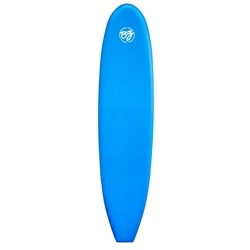
Bz 8' Blue

Surfers never forget their first surfboard. Beginner surfboards are the key to surfing life, so it’s important to make a wise choice when you’re riding the inaugural waves.

Surfboards for beginners have special features. If you’re learning to surf or if you’re introducing a friend/relative to the sport of riding waves, weight and height are the first variables to have in mind.

Floatation demands volume. A good beginner surfboard has high buoyancy so that errors and mistakes made by surfers while catching the balance are easily “forgiven” or tolerated. Stringer technology has been added, too.

Surf novices should buy soft top surfboards that will help them catch as many waves as possible in the early white water stage. Surfing beginners will paddle faster and will rapidly pop up on these stable boards, despite being bigger and heavier than traditional shortboards.

Quality foam surfboards can last forever. They range from 6′ to 8′ sizes. An average adult should get into surfing with an 8′, while a child can learn with a 6′ or 7′. The bigger the board, the faster you’ll be enjoying the pleasures of wave riding.

Surfboards for beginners are quite affordable, and your first surfboard will always be useful, even after progressing to an intermediate surfing level. That’s what a surf quiver is made of. An alternative to foam surfboards are pop-out surfboards, made of molded plastic or very thick resin.

NSP E2 Funboard

After the beginner has become more proficient on the soft board catching waves, standing & turning, the Surfer often wants to advance to a more advanced hard surfboard. A good second choice is often the molded epoxy surfboards from companies like Torq and Surftech. A vacuum molded Epoxy Foam and Fibreglass sandwich wrapped in a ballistic skin ensures that this board can stand up to almost anything.  With modern rails and rocker these boards will help the student advance more quickly and help get them ready for a high performance surfboard.

Posted on

TYPES OF BOARDS

Performance Shortboards

Performance shortboards today are generally boards found in lengths between 5’6″ and 6’6″. The average width falls between 17 1/2″ and 19 1/2″ and thickness of 2″ and 2 3/4″. Nose widths vary from about 10″ and tail widths usually fall between 13″ and 14 1/2″. These basic dimensions are increased or decreased depending upon the height and weight of the rider.

Recent trends in shortboards feature a slightly flatter rocker, with various subtle concave configurations on the bottom. Virtually all are the basic 3 fin thruster design. The center widths have seemed to creep a bit wider along with slighter wider tails.

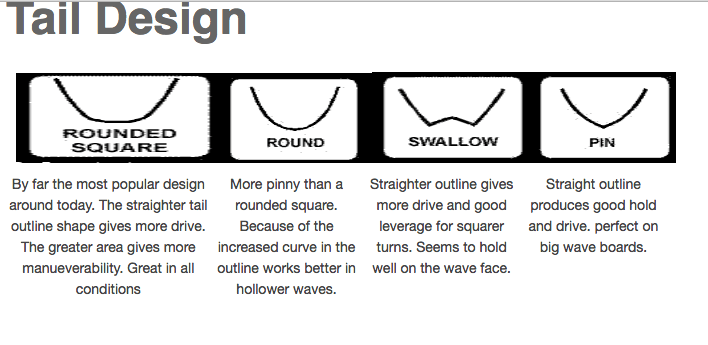
Tail configurations vary wildly in shortboard design…squash tails, round tails, along with swallows and occasional wing designs are all widely being ridden.

For the novice surfer, shortboards can be very frustrating…they are difficult to catch waves on and can be very hard to ride in small weak surf. We always suggest beginners to start with a Funboard shape, learn the basics, and advance to a shortboard later.

water_hog_feature

Funboards/Eggs

Fuboards are aptly named because they allow the Surfer to focus on the purest goal of surfing…To have fun! Funboards incorporate all of the elements of modern design including moderate rocker, performance rails and standard tail designs. Funboards normally utilize the standard three fin setup although you can also find them as 4 Fin Quads and 2+1 setups (smaller side fins with a large center fin). Because of their larger volume and length, it allows the riders to paddle, catch waves, and turn effortlessly. Most shapers will agree that for average recreational Surfers, funboards provide the best of both worlds: the paddling power of a longboard and the turning ability of a shortboard all blended into one.

Funboards work very well in small to medium Surf, however, funboards lose their charm in large Surf. The shape is a great all around board that works well for all Surfers, best is best suited to the beginner or a Surfer making a step down in length from a longboard toward a shortboard.

ci-average-joe

Modern Fishes

The Modern Fish design is a re-invention of a design that came into prominence in the late 70’s. The original Fish was designed by Steve Lis of San Diego. The design features a full nose, full parallel rails ending in a wide swallow tail. The fins were set near the rails. The design was ridden very short generally between 4’10” and 5’6″. and featured a very loose skaty feel, which worked well in small sloppy surf. Today’s Fish is generally ridden in lengths of 5’8″-6’6″. The widths range from 19 1/2″-21″. The noses fall between 11″-13″ and the tails range from 14″-15″. Some designs have wings and most bottoms have generally flatter rocker for increased speed. Today’s fishes are ridden as twins, thrusters and now even Quad 4 fins, although many of the 3 fin configurations use bigger side fins and a smaller trailer fin. Because of the added width, Fishes tend to ride flat on the wave and don’t transition from rail to rail very well making them difficult to surf vertically. However, the flat rocker and quick planing make this very fast design that loves to race down the line and blast past slow sections on a wave. The Fish is best for intermediate to advanced Surfers.

ci-semi-pro

Guns

Guns are serious surfboards for serious surfers. They are designed for riding on the largest days of the year. Chances are if you need this type of board you’re probably not reading this except for the sake of education. Guns are often thought of as a survival tool rather than a performance design, because only the best of designs would be used to survive the giant waves ridden on the beasts.

The objective in Big Wave Surfing is to get into the wave early, get down the face and make the wave. These boards have vee bottoms which create suction and control, essentially holding you on to the face of the wave. The last thing a Surfer wants in giant Surf is to spin out at the bottom of a twenty or thirty foot wave!

Guns need to be thick with the wide point slightly forward of center for maximum paddling efficiency and to help cover a lot of ground in a very short time. Guns are normally thrusters or single fins. This type of board is for expert Surfers only.

walden-magic

Performance Longboards

Since the Longboard resurgence in the late 80’s, the Modern Longboard has truly gone through a revolution in design. While many longboarders prefer the wider, flatter, heavier ride that Traditional Longboards deliver, there’s another group of Surfers that want to push the limits and use all the benefits that a longboard delivers while still doing Shortboard maneuvers. These demands have produced a newer longboard design…the High Performance Longboard.

High performance Longboards are narrower than their traditional brothers, with widths of 21 1/4″-22″. They have increased rocker to allow for faster maneuvers. many Performance Longboards feature greatly increased rocker right in the last 1′-2′ of the tail. They are also thinner with thickness ranging from 2 1/2″-2 7/8″. Almost all feature either a three fin thruster design or a 2+1 fin setup. Many also feature high performance rails and various concave bottom configurations. The magic Model is without a doubt one of the most high performance Longboards ever produced!

Murphy competitor. While the high performance design is much more maneuverable than the standard longboard…there are also drawbacks. While they are usually much lighter than the standard, this is because they are generally glassed much lighter, usually without the final gloss coat. This make them more fragile than the Standard design. Because of their increased rocker, they do not glide as well as the stock designs, but under the feet of an advanced longboarder they are able to reach mach speeds all the while blasting from turn to turn!

modern-retro

Traditional Longboards

Longboards are loved and hated by all. If you’re riding a longboard, you love riding them. If you’re on a shortboard chances are you’ll hate all the longboarders in the line-up. The truth is, riding a longboard puts you as close to the roots of surfing as possible.

On a board that catches any wave with ease, you’ll increase your wave count riding one. You’ll learn or re-learn the simple joy of wave riding. Because of it’s length, width, and thickness, longboards are often referred to as Tankers. The Longboards straight rail line makes it trim effortlessly down the line but requires strength and good technique to perform. Noserider Longboards are often thicker and bulkier with concave in the nose. Most Traditional Longboard bottoms utilize vee, blending from the center and flowing off the tail. Longboards work in any size waves and for Surfers of any skill level from first timers to life long Surfers.