Posted on

LEARN ABOUT FINS

“Everything you wanted to know about Surfboard Fins”

Surfboard fins are a crucial design aspect of your surfboard and its overall performance. Choosing fins that will work best for you and your surfboard depends on your size, ability, riding style and the type of surfboard boxes you have.

Glassed-On Fins

Glassed on fins are laminated directly into your surfboard. Glassed on fins are stronger, lighter and can be stiffer than removable fins. However, glassed on fins can be difficult to repair and do not offer you the versatility of removable fins.

Removable Fins

Removable fins are attached to your surfboard using fin boxes. The fins are either held in using screws or tension. In some fin systems the fins are movable within their boxes to even gain more precise placement. The fins are installed and adjusted using fin keys or a screwdriver. Side fins are different than center fins. Be sure you have installed the correct fin in the box before tightening.

Box Types & Compatibility

There are two major fin systems in use on shortboards today. Funboards and Longboards often use two/four boxes on the sides with a larger adjustable fin box in the center.

Dual Tab Fin Boxes

Dual tab fin boxes have been pioneered by FCS Fins. This is the most widely used fin system in the world. FCS recently introduced the FCS II keyless fin system. In addition to not needing tools to install, the FCS II fins can be adjusted within the box. Older FCS fins will also fit in these boxes.

Single Tab Fin Boxes

Single tab fin systems have been produced by several manufacturers, but the Futures Fin system is the other primary system in use today. Easy set screws hold the fins in place.

Dual Tab and Single tab fins are not cross-compatible!

 Choosing your Fin Size

The primary factor in determining which size fins to use in your board is your weight. Choosing the appropriate fin size is the first essential step to choosing the right fins. Once you have decided on a fin size, examine your boards Fin setup. Your board will be outfitted with 1 to 5 boxes.

Fin Size

The following chart is our recommended fin size by rider’s weight range. If you are in between sizes, consider the type or board and waves you will be riding with the particular fin setup. For example, if you are in between size M and L, you might pick M fins for your small wave board and L fins for your big wave board.

Size Grom XS S M L XL
Weight Under 100 Under 120 105-155 145-195 165+ 190+


Fin Configuration

Once you’ve decided on your fin size, it’s important to understand your board’s fin configuration. To determine your board’s configuration, examine the bottom of your surfboard near the tail. The number of fin boxes you see is the fin configuration and will range from 1-5.

Single Fin

A single fin box is most common on longboards and is the most traditional surfboard fin configuration. Turning with a single fin is limited, meaning single fins are ideal for fast, straight shot surfing. Single fins will provide stability, control, and predictability to your longboard. Longboard single fin boxes are long and allow you to move the fin forward for a looser feel, or further back for more control.

Twin Fin

Twin fins or a dual fin configuration will make your surfboard fun, playful, and maneuverable. Two fin setups are not ideal for big-wave riding and are commonly featured on shortboards to enhance their speed. Twin fins offer a skatier feel and longer, more drawn out turns.

Tri-Fin (Thruster)

Nowadays, 3 fins is the most common configuration and can be found on a variety of surfboard shapes and sizes. The two outer fins are closer to the middle of the board, angled towards the board center (“toed-in”) and can be flat on the inside in order to increase water tracking and speed.  The center fin is the closest to the tail and is symmetric on both sides for stability (see Foil for more info). Tri-fins perform well because they add stability, control, and maneuverability that beginners to pros excel on. A thruster configuration also gives you options – ride twin or single if you want!

4 Fin (Quad)

Quad fin configurations offer speed in smaller surf by channeling the water to the end of the surfboard and out the tail for acceleration.  Two fins near the rails of your surfboard will also add stability and hold in big-wave surfing.  Lastly, quad fins are great for generating drive through turns

Five Fin

Five fin configurations are not meant to be surfed with all five fins. Five fin boxes allow you to mix and match fins depending on your preference and the surf conditions. Swap from the freedom of a twin fin, to the traction of a thruster, to the speed of a quad without changing boards.

2+1 Set-up

2+1 configurations have a longboard single fin box in the middle, with 2 regular thruster side fin boxes to each side. The middle box is longer, allowing you to set your middle fin forward or back. This is an increasingly popular fin box configuration on eggs, funboards, SUPs and logs.

FIN DIMENSIONS AND GEOMETRY

The RakeToeBase LengthFoilFlexHeight, and Cant are important measurements of every surfboard fin, and should be considered when choosing your next surf fins.

The rake, or sweep, is how far the front edge of a fin arcs backwards. Rake or sweep angle is a measurement that determines how far back the fin curves in relation to its base. Fins with a small rake (large offset) help propel the board, are very stable and predictable but are not ideal for making sharp fast turns. On the other hand, fins with a large rake angle and a small offset will allow your board to have a tighter turning radius, but are more “squirrelly” and playful.

Toe/Splay

The toe or splay of a surf fin is defined as the angle of the side fins in relation to the board’s central stringer. Side fins are typically referred to as “toed-in,” with the front of the fin angled towards the middle of the board. This causes water to pressure the outside of the fins, for increased responsiveness

Base/Length

The base length of the fin is the widest point of the fin, and sits flush with the board once installed. This length can affect how the board will respond to turns. Longer fin bases create trajectories for water to go past – so your surfboard will move faster. If you want to make sharp turns, however, go for a shorter fin base length.

Foil

Foil refers to the shape of the outside and inside faces of your fin, thinnest near the tip and thicker near the base. Foil alters the flow of water over the fin surface and has a direct impact on the performance of your fins and board. Middle fins are always symmetrical and convex on both sides (sometimes called 50/50) for even distribution and stability, while outside fins are usually convex on the outside face and flat or curved on the inside. A flat inside face creates a solid balance of control, speed, and playfulness, while a curved or concave inside face maximizes lift with minimal drag, ideal for speed generation and fluidity.

Flex

The flexibility of a fin, or lack thereof, can significantly affect the way a surfboard rides. In general, a flexier fin will provide a skatier feel on more playful waves, but a stiff fin is ideal in faster more hollow waves.

It is important to note that high end fins can be both soft and stiff – they have flex patterns. Many fins now have a stiffer base for tracking and stability, with a softer tip that make it easier to break your board loose while turning.

As a rule of thumb, stiffer fins work well for all ability levels; they are forgiving, stable and predictable, creating a solid platform for progression and big wave riding alike. Soft and flexible fins are great for making fast, sharp turns and will give freesurfers a lively feel to their board, but are more difficult to control compared to stiff fins.

Height/Depth

The height (often referred to as the depth) is measured from the base of the fin to the tallest point of the fin. This measurement can change your board’s stability and ‘grip’ through turns. For surfers who desire a board that is easy to control, a taller fin will be more forgiving and handle turns in a relaxing manner. Shorter fins do not grip the water as well, but rather allow the board to be more “buttery” when turning, ideal for spin-like maneuverers on the water, for example.

Cant

Cant is the tilt of the fin in degrees, in relation to the base of your surfboard. For example, a fin that is straight up down and in the fin box has no cant (90°) and will likely make your ride faster, while anything more than 90° will increase responsiveness. In order to enhance rider-to-board connectivity and responsiveness, especially through turns, you will benefit from canted fins.  The less cant a fin has the more drive and acceleration your board will have but will also be less playful. In turn, the more cant a fin has the looser and more maneuverable your surfboard will feel.
Posted on

BEGINNER BOARDS

Over the last few years with advancements in technology lots of different surfboards designed specifically for the beginning surfer have emerged. Probably the most well known of these have been the epoxy models developed by Surftech. In the four years since NSP was created, they’ve become the largest Surfboard manufacturer in the world!

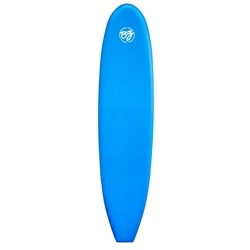
Bz 8' Blue

Surfers never forget their first surfboard. Beginner surfboards are the key to surfing life, so it’s important to make a wise choice when you’re riding the inaugural waves.

Surfboards for beginners have special features. If you’re learning to surf or if you’re introducing a friend/relative to the sport of riding waves, weight and height are the first variables to have in mind.

Floatation demands volume. A good beginner surfboard has high buoyancy so that errors and mistakes made by surfers while catching the balance are easily “forgiven” or tolerated. Stringer technology has been added, too.

Surf novices should buy soft top surfboards that will help them catch as many waves as possible in the early white water stage. Surfing beginners will paddle faster and will rapidly pop up on these stable boards, despite being bigger and heavier than traditional shortboards.

Quality foam surfboards can last forever. They range from 6′ to 8′ sizes. An average adult should get into surfing with an 8′, while a child can learn with a 6′ or 7′. The bigger the board, the faster you’ll be enjoying the pleasures of wave riding.

Surfboards for beginners are quite affordable, and your first surfboard will always be useful, even after progressing to an intermediate surfing level. That’s what a surf quiver is made of. An alternative to foam surfboards are pop-out surfboards, made of molded plastic or very thick resin.

NSP E2 Funboard

After the beginner has become more proficient on the soft board catching waves, standing & turning, the Surfer often wants to advance to a more advanced hard surfboard. A good second choice is often the molded epoxy surfboards from companies like Torq and Surftech. A vacuum molded Epoxy Foam and Fibreglass sandwich wrapped in a ballistic skin ensures that this board can stand up to almost anything.  With modern rails and rocker these boards will help the student advance more quickly and help get them ready for a high performance surfboard.

Posted on

TYPES OF BOARDS

Performance Shortboards

Performance shortboards today are generally boards found in lengths between 5’6″ and 6’6″. The average width falls between 17 1/2″ and 19 1/2″ and thickness of 2″ and 2 3/4″. Nose widths vary from about 10″ and tail widths usually fall between 13″ and 14 1/2″. These basic dimensions are increased or decreased depending upon the height and weight of the rider.

Recent trends in shortboards feature a slightly flatter rocker, with various subtle concave configurations on the bottom. Virtually all are the basic 3 fin thruster design. The center widths have seemed to creep a bit wider along with slighter wider tails.

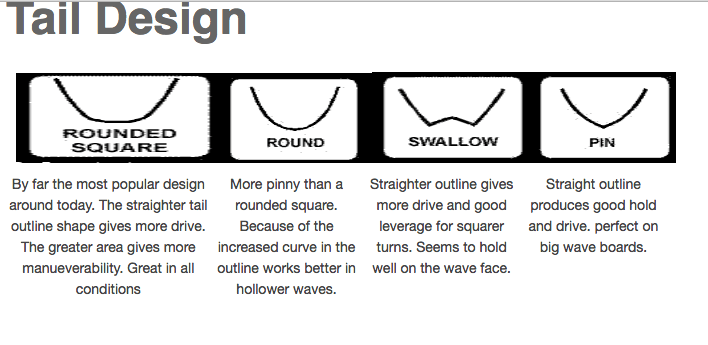
Tail configurations vary wildly in shortboard design…squash tails, round tails, along with swallows and occasional wing designs are all widely being ridden.

For the novice surfer, shortboards can be very frustrating…they are difficult to catch waves on and can be very hard to ride in small weak surf. We always suggest beginners to start with a Funboard shape, learn the basics, and advance to a shortboard later.

water_hog_feature

Funboards/Eggs

Fuboards are aptly named because they allow the Surfer to focus on the purest goal of surfing…To have fun! Funboards incorporate all of the elements of modern design including moderate rocker, performance rails and standard tail designs. Funboards normally utilize the standard three fin setup although you can also find them as 4 Fin Quads and 2+1 setups (smaller side fins with a large center fin). Because of their larger volume and length, it allows the riders to paddle, catch waves, and turn effortlessly. Most shapers will agree that for average recreational Surfers, funboards provide the best of both worlds: the paddling power of a longboard and the turning ability of a shortboard all blended into one.

Funboards work very well in small to medium Surf, however, funboards lose their charm in large Surf. The shape is a great all around board that works well for all Surfers, best is best suited to the beginner or a Surfer making a step down in length from a longboard toward a shortboard.

ci-average-joe

Modern Fishes

The Modern Fish design is a re-invention of a design that came into prominence in the late 70’s. The original Fish was designed by Steve Lis of San Diego. The design features a full nose, full parallel rails ending in a wide swallow tail. The fins were set near the rails. The design was ridden very short generally between 4’10” and 5’6″. and featured a very loose skaty feel, which worked well in small sloppy surf. Today’s Fish is generally ridden in lengths of 5’8″-6’6″. The widths range from 19 1/2″-21″. The noses fall between 11″-13″ and the tails range from 14″-15″. Some designs have wings and most bottoms have generally flatter rocker for increased speed. Today’s fishes are ridden as twins, thrusters and now even Quad 4 fins, although many of the 3 fin configurations use bigger side fins and a smaller trailer fin. Because of the added width, Fishes tend to ride flat on the wave and don’t transition from rail to rail very well making them difficult to surf vertically. However, the flat rocker and quick planing make this very fast design that loves to race down the line and blast past slow sections on a wave. The Fish is best for intermediate to advanced Surfers.

ci-semi-pro

Guns

Guns are serious surfboards for serious surfers. They are designed for riding on the largest days of the year. Chances are if you need this type of board you’re probably not reading this except for the sake of education. Guns are often thought of as a survival tool rather than a performance design, because only the best of designs would be used to survive the giant waves ridden on the beasts.

The objective in Big Wave Surfing is to get into the wave early, get down the face and make the wave. These boards have vee bottoms which create suction and control, essentially holding you on to the face of the wave. The last thing a Surfer wants in giant Surf is to spin out at the bottom of a twenty or thirty foot wave!

Guns need to be thick with the wide point slightly forward of center for maximum paddling efficiency and to help cover a lot of ground in a very short time. Guns are normally thrusters or single fins. This type of board is for expert Surfers only.

walden-magic

Performance Longboards

Since the Longboard resurgence in the late 80’s, the Modern Longboard has truly gone through a revolution in design. While many longboarders prefer the wider, flatter, heavier ride that Traditional Longboards deliver, there’s another group of Surfers that want to push the limits and use all the benefits that a longboard delivers while still doing Shortboard maneuvers. These demands have produced a newer longboard design…the High Performance Longboard.

High performance Longboards are narrower than their traditional brothers, with widths of 21 1/4″-22″. They have increased rocker to allow for faster maneuvers. many Performance Longboards feature greatly increased rocker right in the last 1′-2′ of the tail. They are also thinner with thickness ranging from 2 1/2″-2 7/8″. Almost all feature either a three fin thruster design or a 2+1 fin setup. Many also feature high performance rails and various concave bottom configurations. The magic Model is without a doubt one of the most high performance Longboards ever produced!

Murphy competitor. While the high performance design is much more maneuverable than the standard longboard…there are also drawbacks. While they are usually much lighter than the standard, this is because they are generally glassed much lighter, usually without the final gloss coat. This make them more fragile than the Standard design. Because of their increased rocker, they do not glide as well as the stock designs, but under the feet of an advanced longboarder they are able to reach mach speeds all the while blasting from turn to turn!

modern-retro

Traditional Longboards

Longboards are loved and hated by all. If you’re riding a longboard, you love riding them. If you’re on a shortboard chances are you’ll hate all the longboarders in the line-up. The truth is, riding a longboard puts you as close to the roots of surfing as possible.

On a board that catches any wave with ease, you’ll increase your wave count riding one. You’ll learn or re-learn the simple joy of wave riding. Because of it’s length, width, and thickness, longboards are often referred to as Tankers. The Longboards straight rail line makes it trim effortlessly down the line but requires strength and good technique to perform. Noserider Longboards are often thicker and bulkier with concave in the nose. Most Traditional Longboard bottoms utilize vee, blending from the center and flowing off the tail. Longboards work in any size waves and for Surfers of any skill level from first timers to life long Surfers.

Posted on

SURFBOARD CONSTRUCTION

Surfboard construction has come a long way since the days of wooden boards. Foam blanks were introduced in the 1950’s and revolutionized Surfboard construction. In the last few years, space age technologies have begun to re-revolution surfboard construction. Below is a breakdown of some of the most popular types of construction in use today.

Polyester is the traditional type of Surfboard construction in use since the 1950’s. A shaped polyurethane blank is glassed by hand using fiberglass cloth and polyester resin. several layers of resin are applied to the board before it is sanded and given it’s final finish. These boards simply feel good, look clean and ride unreal.

technology_poly_img

Epoxy Surfboards are made with either an EPS (Expanded Styrene) or an XPS (Extruded Polystyrene) blank. The EPS blank is a beaded foam which is much like those found in beer coolers. It is an open cell foam that absorbs water like a sponge if exposed to water. The Extruded blank has a closed cell core and is much more resistant to compression and damage. Fiberglass cloth and epoxy resin are used to hand glass the blank. The glassed blank is then finished in the traditional method. Using epoxy resins create a more lightweight durable board.

technology_slx_img

SLXC Epoxy pioneered by Global Surf, the SLXC features a stringerless carbon railed blank which is glassed using vacuum bag technology. The combination of stringer removal, carbon biaxial rails and biaxial deck fibers helps keep the surfboard from twisting in a turn keeping the flex from nose to tail. This makes the board feel very responsive and alive under your feet.

technology_slx_img


Future Flex, another technology pioneered by Global, the blank is a high density EPS. The key to the flex pattern is the parabolic carbon fiber frame constructed with the laminate. The carbon fiber frame is designed to maximize speed and drink while maintain a flex pattern that flows in the wave.

technology_futureflex_img

Technology Carbon Vector Lrg Carbon Vector
Carbon Vector (CV) construction delivers unmatched performance by harnessing the flex characteristics of epoxy and the strength of carbon. CV combines a stringerless, high-density custom shaped EPS core laminated with biaxial fiberglass, epoxy resin and a distinctive carbon fiber webbing, (positioned on the bottom and around the rails).
The carbon fiber webbing serves to evenly distribute tension across the entire surface area of the board to produce a lively, yet controlled flex pattern with remarkable memory recall. The biaxial fiberglass on the deck serves to add strength and also help prevent delaminating. CV boards feel fast, light and highly responsive in all conditions.
Created by GSI to compliment a range of board models and designs, this construction has proven to have superior flex properties over our other board technologies by up to 20%.


CARBON WRAP TECHNOLOGY

CARBON WRAP™ Is a patented surfboard technology, structurally engineered for optimum flex and performance. Originally created by Gold Coast surfboard manufacturer, Dan MacDonald, to be light weight without sacrificing strength and provide #nextlevel performance. Carbon Wrap eliminates the standard wooden stringer, alters traditional flex principles and re-envisions the way a surfboard’s flex patterns are created and controlled. Ultra-light, EPS cores are “wrapped” in an exoskeleton of strategically positioned, carbon fiber bands. Aligned together at the nose, they gradually curve outward towards the rails. The curve creates and controls a unique torsional flex that livens up as it nears the tail, just in front of the fins. The carbon then “wraps” from the bottom, around the rails and onto the deck. This unique method creates Carbon Wrap’s lively flex that loads and releases…resulting in nextlevel speed and drive. Running along the rails, on the deck, the carbon acts as a rear foot power point, (increasing drive and control) and a patch to minimize pressure denting. Using optically brightened epoxy resin, the boards are encased with a proprietary composite of fiberglass and our exclusive carbon deck inlay, which is strategically positioned to add fast re-flex memory under the surfer’s stance and allow subtle, natural deck caving around the arch of the front foot. By tapering the carbon into long, pointed ends, forward and aft, the flex blends out naturally towards the nose and tail.  A full layer of 45degree “X-Glass”, encases the deck. The X-Glass’s flat, bi-axel weave dramatically adds strength without rigidity, or excess weight and allows the board to maintain flex while alleviating crease points created by standard, 90degree fiberglass. The 45degree weave radiates foot pressure outward, directly connecting the foot to a longer section of the rail, adding greater edge control. CARBON WRAP TECHNOLOGY: Lightweight, without sacrificing strength.  Increases drive and provides and unique and lightning fast re-flex effect,  propelling your surfing into the #nextlevel of performance.

FLEXBAR TECHNOLOGY

Introducing patented Flexbar technology by Channel Islands and Barron Flex. Flex, rebound, and resonance all play a role in how your board works. Harnessing and controlling these will take board performance to the next level.  The Flexbar optimizes the energy and spring derived from both longitudinal and torsional tail flex in your surfboard by refining and focusing these forces under the back foot. Utilizing a combination of alternating foam densities and fiberglass through the entire board, Flexbar finally allows the surfer to feel and use the energy in your board through maneuvers.  All surfboards will eventually lose their “pop” and begin to feel dead, Flexbar maintains the optimum flex pattern through the life of your board.  All of this backed up by a one year warranty against breaking (read the warranty HERE), Flex-bar technology is the ultimate in performance

Spine-Tek

Channel Islands is proud to announce our collaboration with Shapers Australia to launch SPINE-TEK; a precision engineered stringer spine utilizing a unique composition of fiberglass and resin. SPINE-TEK is based on the principles of elastic energy, to flex under pressure and then return the surfboard back to its natural rocker, providing surfboards with a more lively and responsive feel.

Performance through innovation, SPINE-TEK® is a world’s first with its unique fiber-based composition, delivers optimal flex based performance through the principles of elastic & kinetic energy. Through this process the surfboard loads up on energy and then releases, generating additional drive, speed, power & flow.

Weighing a mere ¼ of a pound and installed in the surfboard deck, SPINE-TEK replaces the traditional heavier timber stringers and is virtually break free.

Posted on

LEARN TO SUP IN NEW JERSEY

Eastern Lines has been serving Ocean enthusiasts in New Jersey since 1981. Our Mantra has always been……. Soul – Tradition & Experience! We would love everyone to enjoy the exhilaration of spending time on the ocean and waterways. Anyone can learn to Surf, but the explosion of SUP’s has offered many more people the opportunity to experience the Ocean Lifestyle we love!

We offer Lessons to those new to the sport on the calm waters of Shark River. A lesson is important to learn the correct techniques of SUP, to make your paddling adventure the most fun and beneficial.

Our lessons begin on the beach where you become familiar with the board and the paddle. In just a short time we’ll have you out on the water paddling and enjoying the day! After just one lesson most students are comfortable enough to proceed on their own, but we do offer additional lessons for those that need more confidence or want to further improve their SUP techniques.

As your skill levels improve, we do offer introductory SUP Surfing lessons. Taking an SUP into the ocean is a completely different experience than flat water paddling. Only those that are proficient paddlers and are confident controlling their board should venture into the surf. If you are ready…… we can help give you the tools to ride that wave!


LESSONS

Beginner – 1 ½ hours @ Shark River (up to 2 people)

Paddleboard and paddle included in lesson – $150.00 each

If you have a larger group we can provide additional instructors and discounts!

Beginner Surf Lesson – 75 Minutes in Belmar in the ocean – $90.00

We offer lessons 7 days a week from May into October. All you need to do is call the shop @ 732-681-6405 and we’ll get you set up. Our lessons are tailored to your schedule……. Mornings, Afternoons, Evenings, Weekdays or Weekends……..

Posted on

LEARN TO SURF IN NEW JERSEY

Surfing is lots of Fun and one of the fastest-growing natural sports today. Nothing can match the feeling of paddling for an open Ocean swell, catching the wave, jumping to your feet, and riding a wave formed of pure ocean energy! In addition to Surfing, we also offer lessons in Bodyboarding and the new sport of Stand-up Paddle Surfing! Our experienced staff of Instructors will guide you through all the essential fundamentals needed to get you started on your Ocean Adventure……..

Beginners start with the basics of water safety, paddling and wave selection. We stress Safety! All of our Surfboard lessons are given on soft Surfboards. The site is determined by our instructors to optimize your safety, fun and learning experience. We teach at your pace and cater to the individuals or groups and their abilities.

Intermediate Surfers can benefit from advanced lessons from our instructors on bottom turns, top turns, cut-backs, barrel riding, reading swell directions, conditions and more!

We offer Lessons 7 days a week from late May through September. All you need to do is call the shop at 732-681-6405 and schedule an appointment!

We now offer Lessons in the new fast-growing sport of Stand-Up Paddle Surfing! We offer individual one on one lessons both in the river and ocean to introduce you to the basics needed……….

Our Lessons are tailored to your needs and schedules……. Mornings, Afternoons, Evenings, Weekday or Weekends!

Rates
Surfing Private Lesson : $90.00/ 75 Minutes

3 pack of Private Lessons $240.00

Surfing Group of 2 : $85.00/ each – 75 Minutes

Surfing Group of 3 : $75.00/each – 75 Minutes

Bodyboarding Private Lesson : $85.00/ 75 Minutes

Stand-Up Paddling (up to 2 people) : $150.00/ 90 min (includes board & paddle)

All lessons include use of Boards!

To schedule a Lesson call 732-681-6405