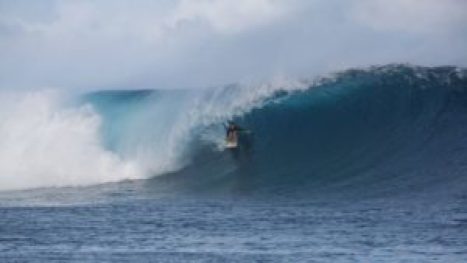
Think of the Faroe Islands like the North Atlantic’s answer to the Pacific islands of Hawaii: a rocky archipelago sitting alone in the middle of the sea, buffeted by huge ocean swells passing by. Only, this isn’t boardies territory. The Faroes lie roughly halfway between Iceland and Denmark, a stone’s throw from the Arctic circle. Thick, full-body wetsuits are required to survive the freezing cold water. On shore, the climate is too harsh to support agriculture so the Faroese get by on a diet of mostly sheep and fish.
So, why did filmmakers Chris Burkard and Ben Weiland make the pilgrimage to these inhospitable islands, with surfers Dane Gudauskas, Justin Quintal, Sam Hammer and Tyler Warren in tow? The promise of never-before-surfed spots, incredible waves and a unique culture left largely disconnected from the rest of the world, proved too much to resist.
But it was no easy task.Faroes – the Outpost Vol. 02 documents their adventures and the challenges of surfing the huge waves that slam against the towering sea cliffs around the island.
The Outpost series is all about the search for unexpected and unusual spots in hard-to-reach and lesser-travelled corners of the globe. With a strong sense of discovery, it’s a story of the journey and culture as much as the stoke. Faroes follows Vol. 01, set in Russia’s arctic Kamchatka peninsula.
Huck spoke to writer and co-director, Ben Weiland to find out more.
How did your Outpost series come about?
When Chris Burkard and I planned the first film project to Kamchatka, Russia, we thought it would be interesting to create a series of short films about surfing and adventure in unusual, remote places. They’re places both of us are drawn to, and we loved the idea of carrying a consistent thread throughout the films.
When did the Faroes first come up on your radar? What attracted you to the islands?
Four years ago I was skimming around Google Earth when I spotted a tiny speck of islands near Iceland I had never heard of, and it turned out to be the Faroe Islands. I began looking for signs of surf, but the more I researched, the more I realised that surfing there was no easy task. The rugged landscapes and isolated location fascinated me. The place looked like it had been frozen in time for thousands of years.
How tough is it to surf the Faroes?
It is very tough. While some people think it’s crazy to surf in freezing cold water, I’d say the main surfing challenge was access. The islands are small and fragmented, walled by sea cliffs and slammed by gigantic North Atlantic storms. For us, looking for a place to surf was like scouring a maze. There were many potential spots to check, but it was time consuming and we came to a lot of dead ends. It took a lot of patience, and in the end we were blown away by the waves we found.
What’s the attraction in never-before-surfed waves?
To me it’s the idea of discovering something incredible that previously was not known. When I’m looking at a map, the unanswered questions draw me. There are a small number of breaks in the Faroes that had been surfed before, and we even heard of one Faroese resident who was a surfer, but within such a dense tangle of islands I couldn’t help but wonder what else was out there.
What’s your best memory from the trip?
While we walked along the beach at night to see if the surf was coming in, a local resident approached us in the dark and invited us into his house. He asked us to try fermented lamb meat which he had been curing for nine months in a shed behind his house. It was purple and coated in green mould. Both of us tried it, but we could barely keep it down.
Paradise on the edge of the map with Dimity Stoyle, Andy Schwartz and James Wood.
Article provided by World Surfaris
In early November 2014, Tracks & World Surfaris took three very different surfers to East Java. Pro surfer Dimity Stoyle, the soul-surfer & big wave charger Andy Schwartz & the former Under 16 & Under 18 World Champ & knockabout comedian James Wood. They discovered the pleasures of uncrowded waves in Pacitan & enjoyed the delights of the IstanaOmbak Eco Resort. The trip was recorded in the DVD “Know Where To Go”, which was released in the April issue of Tracks.
The IstanaOmbak resort sits in the middle of a picturesque bay, fringed by palm trees & bookended by tall cliffs. A left hander peels down one side of the bay – a right hander peels down the other. The channel in the middle makes for an easy paddle-out, from the beach, to your preferred takeoff zone. And when it’s on, it barrels.
IstanaOmbak has a delightfully refreshing approach to hosting surf adventures. The all-inclusive pricing includes as much food and beer as you can drink. The menu is not set & repeated & recycled each week. The kitchen staff uses the seasonal produce that is fresh & best to produce dinner each night. During the day (with some minor restrictions), you can eat your choice of meal at whatever time you like.
If you would like to experience the magic of IstanaOmbak, World Surfaris are offering free travel insurance for the duration of your stay at the resort (including travelling time) for anyone making a booking for IstanaOmbak before 31 May 2015. Actual travel can occur anytime within 18 months of the booking date.
Maui, also known as the “Valley Isle,” offers many different beaches with waves suitable for all surfing skill levels. Here, all of the best breaks are reef breaks, and the varying sizes and formations of the coral make for plenty of shapely waves. There are a few available beach breaks, although they tend to be mediocre in quality compared to the reef breaks.
Maui waters are, for the most part, crystal clear, and the reefs below will provide you with plenty of marine life to check out while you’re waiting for a wave. Be sure to wear booties or reef shoes, and watch your hands in the shallower areas during paddle out. Some other hazards include sea urchins, jellyfish and tiger sharks; if you get cut by reef or sharp coral, make sure to exit the water immediately.
On the southern and western shores of Maui, the summer waves consist of long, gently rolling sets, ideal for learning how to surf. There are some beautiful beaches along the west coast resort towns of Lahaina and Kaanapali, and a lot of good surfing schools. Many of the surfing schools on Maui guarantee stand-up surfing after the first lesson, and in some of the more shallow areas, you don’t even have to know how to swim to surf! Although tricky, as long as you’re comfortable being in the water, it’s possible to catch a long, easy wave close to shore. On the south coast of Kihei, at Maalea Beach, beginners can learn to surf at Buzz’s Wharf.
There is also plenty of experienced to professional world-class surfing on Maui, especially on the north coast and in the winter. Honolua Bay on the north shore is home to a mesmerizing right-hand point break, and Hookipa is known as the best place in the world to windsurf. Peahi, also known as Jaws, is where tow-in surfing originated, which is the only way to access this enormous wave when the right north winter swell is coming in. Surfed only by experts, Jaws is one of the biggest ridable waves on the planet, and can reach up to 50 feet overhead. During a southern swell, more experienced surfers flock to the Maalaea Pipeline, arguably the fastest right-hand break in the state.
Good surfing conditions can be found on Maui year-round. The water temperature remains in the 70’s and can reach the low 80’s in September and October.
The North Shore of Maui is where you’ll find the biggest and most consistent waves. Hookipa is a great surf spot when winds are favorable with 3-4 main breaks. This Maui surf spot is for experienced surfers only. The current can be strong and there are only 2 entrances to the surf. The reef infront of most of the spots is exposed which makes it difficult to get to shore when the currents are blazing. The entrances are at either end of the beach and narrow. The waves here are good but crowded.
Another popular spot to surf is Honolua Bay. This is one of the best waves on the island though extremely fickle. Usually only breaking a handful of times in the winter, Honolua Bay can offer a really long barreling right hand wave. Again, only for advanced surfers, Honolua surf can be treacherous. The Cave is a section of the wave, which is notorious for sucking surfers under and keeping them there. Keiki Bowls, on the inside, is super shallow and fast. This is a fun part of the wave, but you don’t want to fall here. Just kicking out can leave your knuckles scraped when paddling. There are dozens of other reef breaks around the island. The few beach breaks available are usually not very good in comparison.
Honolua Bay
Honolua Bay is not only the best wave in Maui, it is one of the best in the world. The northwestern coast of Maui is riddled with bays and crags that can produce all variety of great surf during the winter months, when the North Pacific is busy churning out storm after storm. But as any surfer knows, even a single degree change in the angle of a coastline can make the difference between a good wave and a perfect wave. Honolua Bay has just that magical angle, producing a perfect right-hander that can line-up flawlessly in a series of barrel and turn sections for the better part of a quarter mile. Like most high-quality pointbreaks, Honolua Bay is broken down into sections:
Coconuts: The outermost take-off zone on the point. As to be expected, the waves will be biggest here, but the wind will also be strongest.
Outside: After hitting Coconuts, the wave begins to gather steam and form, and will stand up into a hollow wall that offers the first of multiple barrel opportunities.
Cave: The best, most popular and high-performance, section of the wave. At Cave, wave height gives way to wave thickness as swell runs down the point, offering up the opportunity for the barrel of a lifetime. This section is named after the hole in the reef that gobbles surfers and surfboards with reckless abandon during big winter swells.
Keiki Bowl: If you’ve made it through Cave on a proper set wave, you’re probably burning off the steam of a deep barrel, which will get you into the next section, Keiki Bowl. Keiki is smaller, racy, and breaks over shallow, sharp reef — a favorite of bodyboarders and groms not quite ready for graduation to the outer take-off zones.
Ho’okipa
While wind/kitesurfing and surfing don’t usually play well together, Ho’okipa Beach Park, on Maui’s north-central coast, is the exception to the rule. With an unobstructed window to the North Pacific, Ho’okipa can pump out some serious surf in the winter months — best for surfers in the early morning hours when the predominant East-Northeast trade wind has yet to flair up. Ho’okipa consists of four different spots:
Pavilions: The most easterly spot, just below the Ho’okipa Lookout. Pavilions is predominantly a right-hander and is a better choice for surfers.
Middles: Heading west from Pavilions is Middles, the main spot for surfers. The wave breaks both right and left, though the lefts handle the wind better.
H’Poko, or Point: Located on the west end of Ho’okipa Beach, Point offers up fun right-handers in the morning but becomes the sole domain of the wind/kitesurfers in the afternoon.
Lane: Just west of Ho’okipa Beach is Wana Beach, where Lane is located. You can pick off both rights and lefts but, like Point, Wana gets blown to bits in the afternoon
Kahului Harbor
Located on the north-central coast, is Kahului, Maui’s largest city and most important hub, home to the island’s main airport and largest harbor. While hardly the desolate, picturesque surf spot that hopeful Hawaiian travelers may imagine, Kahului Harbor is a worthy — and super fun (for the more experienced surfer) — place to get your feet wet. There are several good breaks inside and outside of the harbor, which all light up on a solid North swell, but the best wave is the right on the west side of the harbor. Large swells push through the wide entrance with energy refracting out of the deeper channel and crossing up with swell energy bouncing off the jetty, creating a powerful roll-in wedge over shallow water. This mini Box-like wedge is a favorite of bodyboarders and surfers adept at negotiating abrupt steps and chucking barrels. There is a left off of this same peak but it dumps into the deep water of the channel, thus not offering much. As you can imagine, Kahului Harbor is often crowded and polluted. On top of that, watch out for urchins, rocks, tricky rip currents, and the occasional shark. Despite the many obstacles, a Kahului Harbor right tube is an experience worth attempting.
Peahi (Jaws)
Where the Hana Highway bends away from the ragged sea cliffs of Maui’s north central coast, and begins winding south and east through patches of sugar cane fields on its way to Hana, sleeps the surf spot that needs no introduction. First surfed by tow-in pioneers Laird Hamilton, Buzzy Kerbox and Darrick Doerner, Peahi, or Jaws, has become a tow and paddle mecca for big wave surfers the world over. A deep-water wave, Jaws only breaks in the biggest winter swells. If you’re a visiting surfer in Maui when such a swell hits, it’s worth the trip out to bluffs overlooking Peahi for one hell of a show. As we hope you recognize, this is a kamikaze-only surf spot — watching is frightening enough!
Ma’alaea Harbor
While not the swell magnet that fellow west coast harbor break Lahaina is, Ma’alaea is one of Maui’s most famous waves. This is in part for the rifling, perfect right-hand tubes it creates on just the right South or South-West swell; in another part for the decades-long fight to preserve Ma’alaea’s existence as a world-class, albeit rare, surf spot. (Fortunately, in May of 2012, federal and state agencies ended the project that would have expanded a portion of the Ma’alaea Harbor and effectively destroyed the wave, thus ensuring Ma’alaea will remain a jewel in Hawaii’s pantheon of incredible surf breaks.) Once considered the “fastest wave on earth,” Ma’alaea has attracted brave barrel riders from within Maui and abroad for decades, thus the crowd can become as intense as the wave itself. Because of its size, the crowd, and the reef bottom, Ma’alaea is considered an expert-only spot, though there are more manageable peaks nearby during smaller South swells.
Challenges when surfing in Maui
Hawaii is the Mecca of surfing. Although Maui is not known as the center of the sport, our island has some incredible breaks. Oahu’s North Shore is the best spot for surfing good-sized waves with good shape. Maui has many downfalls when it comes to surfing, but if you learn about them, you can score good rides.
The following will explain the good and the bad of Maui surfing and how you can get the best out of your surfing experience in Hawaii. IMPORTANT: Remember safety should always be your first priority. If you doubt, don’t paddle out!
Local Tension
For visitors to Maui, localism possesses a major threat to a fun surf session. If you’re inexperienced or have a tendency to drop in on other surfers, don’t paddle out. If you get in the way of others, or keep paddling around people to the peak, don’t paddle out. If you are threatening and disrespectful, don’t paddle out. The local surfers are not happy about the last 10-15 years of surfing invasion on Maui. There aren’t enough waves on Maui for everyone to be happy. Most of the times you’ll find that everyone out in the water knows each other. This can be a problem for a new face trying to get in on the lineup.
Remedy: Bring plenty of Aloha into the water. Wait your turn, and don’t bark when someone drops in on you. Be respectful and treat people the way you’d like to be treated. Some Maui surf spots are known for antagonistic local vibes. Stay clear of these spots. There are a lot of surfing locations on Maui, which means you can usually find a break that’s less crowded and less perfect. At the more popular surf spots, bring your patience and extra time to sit and get your fill.
Crowds
If you’ve come to Maui to get away from crowds, think again. Almost all Maui residents surf in some shape or form. Some only go out once a year, others are out 3 times a day. Like anywhere, the better spots are the most congested. Honolua Bay, when it’s working, is the busiest surf break on the island. Even the smaller and lesser-known spots are known by enough people to make it cramped.
The Good Points
You’re surfing in Maui! The water is warm year round. It can get a little chilly in the winter with the wind factor, but a vest or springsuit can cure this. The ocean water here is also crystal clear. Maui water is really clean and free from pollutants. The clarity offers you a chance to even enjoy the flats between sets by watching tropical fish and vibrant reef below you. During whale season, you can see the humpbacks breaching the water and playing nearby. Many good surf spots are choke full of sea turtles, which can also be fun to see. If the right swells hit them, our reefs can produce the perfect waves. Maui is also great for surfing because it’s small enough to get to any shore in less than 3 hours. The Big Island is not so fortunate in this aspect. Having Oahu and Kauai so close by is also a major plus. Getting waves on these islands is worthwhile and not a long trip away.
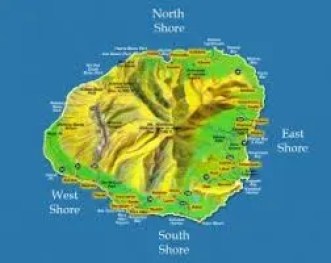
Kauai clutches your senses and embraces your natural instincts for adventure and outdoor living. It lies just over 100 miles northwest of Oahu, across the Kauai Channel. It is the fourth largest island in the Hawaiian archipelago, much of which is national park.
The oldest of Hawaii’s main islands, Mother Earth has had time to out on an unbelievable show. Also known as the ‘Garden Isle’, Kauai is renowned worldwide by hikers and kayakers for its breathtakingly beautiful trails. Discover heavenly beaches and soaring cliffs, from the surf mecca of HanaleiBay to the chasms of Waimea Canyon.
Weather in Kauai
Kauai’s climate is considered to be subtropical, notwithstanding its close proximity to the equator. The humidity and temperatures are not as severe as other tropical destinations, with the average temperature in summer being 27°C. Kauai climate remains quite consistent year round due to the refreshing trade wind that blows off the ocean.
The best times to visit Kauai are the season of summer and spring, between April and August. The autumn and winter months are generally less crowded, however this is the island’s wet season.
Getting There
Today getting to Kauai is much simpler and faster than in years past. You can get a non-stop direct to Oahu and a quick Hawaiian air flight and there you go. About 10 hours and your there. There is also a non-stop to San Francisco with a connecting flight direct to Lihue. Check the prices for your best deal
Surf Spots
Although there are fantastic spots on each coast of Kauai, the Spot is Hanalei on the North coast. Open directly to the Winter North Pacific swells, it catches every swell and can often be a few feet bigger than Oahu.
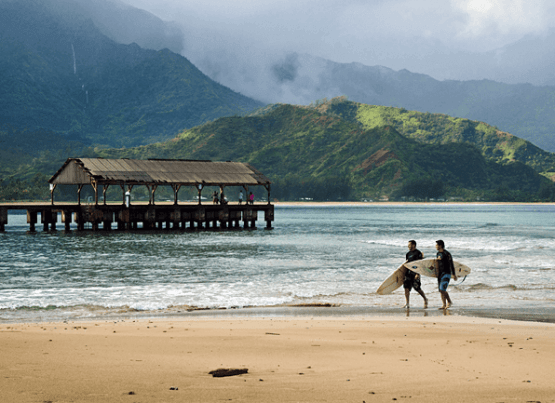
Hanalei Bay is one of the most well-known spots on the island, and there are many other spots in and around the bay. Hanalei itself is a long right point that breaks on the western side of the bay, breaking for up to 300 yards over lava reef. It is a fairly powerful wave with occasional barrel sections that ends with an inside bowl section in the middle of the bay.
Farther north, up and around the point from Hanalei, is a reef break right called Hideaways. Further inside the bay is an inconsistent break called Pine Trees, which needs a larger swell and a good sandbar set-up at the river mouth. Directly across Hanalei Bay from the main point is a fickle left reef break called Waikokos, which needs a large north swell and west wind.
Ha’Ena Bay (Cannons/Tunnels)
Heading west past Hanalei and Wainiha Bays, you’ll run into beautiful Ha’ena Beach, a goofy or regular footer’s dream in the winter. On the eastern side of the shallow bay is Tunnels, a right-hander breaking over shallow reef that on a proper North-East swell quickly makes you realize this wave has a very appropriate name. The paddle-out to Tunnels is a long one, but gets you warmed up for the waves waiting beyond. On the other side of the bay is Cannons, an equally hollow and shallow left that really gets going on a solid North-West swell. The paddle-out to Cannons isn’t as long as Tunnels. Like most surf spots in Kauai, Ha’ena is breathtaking — crystal clear water and jagged green mountains rising beyond the white sand beach. Ha’ena is, however, a popular surf spot, especially in winter, and visiting surfers should pay special attention to the local crew in the water at all times.
Anahola Bay
Anahola Bay is usually a mellow spot that is good for all levels (depending on swell size). Located on the northeastern lobe of the island, Anahola Beach is classic Kauai. The Kalalea Mountains rise to the west, the beach sand is white, and the waves break beyond a tranquil inside, out on the northern edge of the barrier reef. The inside is great for snorkeling and the grommets, with a fun bodyboarding and/or bodysurfing shorebreak near the mouth of Anahola River. The main wave, which breaks over reef and can be only for intermediate to experienced surfers when the waves are pumping, has a wide swell window from the North Pacific and favors south-to-west wind that is common during the passage of storm fronts, which are common in the winter months, when Anahola’s potential is at its best.
Polihale
Heading northwest on Kaumaualii Highway, just past Barking Sands beach and Mana Point, you’ll hit the end of the road at Polihale State Park. Before you will be seven miles of sweeping, golden beach that ends at the colossal feet of the Na Pali Coast, where the untouched wilds of Kauai’s western shore begin. Along Polihale beach there are numerous beachbreak set-ups to enjoy in both summer and winter. Unlike nearby Mana, Polihale picks up more swell from the North than the South Pacific, though a good South swell will wrap in just fine. Like Polihale, combo swells will yield the best surf, distributing fun peaks up and down the beach. Because Polihale is so sweeping and predominately sand, watch out for shifty surf and strong currents during larger swell events. If you’re on Kauai, whether there is surf or not, you don’t want to miss Polihale State Park — it’ll mesmerize you.
Pakala
Pakalas is a long left that barrels as it wraps around the point on the south side of the bay. It is fast, powerful and best on an overhead swell. The lower the tide, the hollower Pakalas gets, but exercise caution because the bottom is coral reef. On weaker swells, Pakalas is far less hollow and a mellower surfing experience overall. Checking Pakalas is a bit tricky, as you can’t easily see it from the road. Follow the cars parked along the side of the road.
There are many other surf spots littered all along the coast of Kauai. One of my favorites was Majors Bay. I heard about it from a local who said it was best on a North-West when it was big. After driving all over the Western side of the island, we could see the surf but couldn’t figure out how to get to it. Barking Sands Naval Base stands along a larger area blocking access to the Surf. After going crazy, we finally stopped a carload of locals and asked them, How do we get to the Surf?
They told us you just go up to the main gate and tell the heavily armed military guards you want to go surfing……….. Crazy! They just give you a pass and let you on to a nuclear missile base. Take the trip, it’s definitely a great wave and experience!
Friendly Faces, Beaconing Breezes and Voluminous Volcanos.
The political history of Nicaragua along with it’s many natural disasters have made traveling to this Central American Country a curse to many potential visitors. Unfortunately, positive news about Nicaragua is rarely heard, making you wonder if anything has changed within the course of time. Well plenty has changed since the time of the Sandinistas. Nicaragua is in it’s second decade of stable democracy and combined with less investment in military and more investment in education and health gives hope to other developing countries.
When to Go
The Pacific coast of Nicaragua has a plethora of different point breaks and beach breaks that work all year long. The best time to be there is spring and fall. The waves are best during the summer which begins the rainy season. This can be an ugly muddy time to get around as any Central American traveler will tell you.
The Surf
The best thing about the surf in Nicaragua is Lake Nicaragua. What??? A Lake? Yes, this magical lake which sits in the lower middle of the country is so big it regenerates the trade-winds from the Caribbean and creates perfect offshore winds all year long. It also has a massive volcano in the middle called Concepción. The winds work pretty much all day long unlike Costa Rica where you have to get up super early to have a fun session. This is important to the hung-over surfer who mainly surfs in the afternoons. An added bonus to the constant offshore breeze is the absences of annoying bugs which can ruin a trip if not careful.
Getting Around
Managua is the capital and where you mainly fly in from the States. The airport is pretty tiny and the rental car companies will try to scam you. Make sure you have an agreement with a rental company before you arrive as the prices jumps substantially when trying to make arrangements on the spot. Managua is a real tricky city because there are no street signs. Directions are all made based on landmarks which makes it close to impossible to navigate for newcomers. It may be a good idea to have a GPS or hire someone to get you going in the right direction. The roads in the cities and the Pan-American Highway are pretty good. Once you make it to the coastal area you’re going to wish you rented the bad ass 4 Wheel Drive Toyota Hilux. Even though it’s not necessary to have a 4WD during the dry season it does help.
The People
The people of Nicaragua are the most approachable people in the world. They are super happy to have people from all over the world visiting their country. Not many people speak English so having a decent Spanish vocabulary will help tremendously. They’re also very modern and all have cell phones which is pretty amazing for a developing country. The majority of the country is Catholic which you notice when visiting the cities. Many beautiful churches and cathedrals work their way into the cityscapes. Especially in Grandada which is an old colonial city that makes you feel as if your in 16th century Spain.
Where to Stay
Rivas County is where much of the action is in Nicaragua. It sits in the southern part of the country near Lake Nicaragua. Finding a place to stay near the surf is pretty easy and not too expensive. Popoyo is the backpacker’s nugget. It offers cheap places to stay and a pretty vibrant local cuisine. The wave there is one of the best in the country and breaks at all tides. You can also get to other breaks near by with very little hassle. Further south is Rancho Santana which has much nicer places. It has a very elegant restaurant, a few pools and access to wifi. Santana is the beach break many locals like to frequent. It usually breaks best at mid-tide. A bit further south is Playa Iguana which is similar to Rancho Santana and offers some really nice places to rent. Here is where you find Panga Drops and Colorados. These two waves are really fun and can get you tubed all day long. Even further south is Gigante and San Juan del Sur. There are many different breaks in this area and offer more city flavor and wide variety of places to rent.
If you’ve ever seen a pirate movie, or dreamed of an idyllic castaway surf locale, then you’ve probably seen or envisioned a setting very much like the BVI’s. Lush rolling green hills cradling bright white fine sand beaches fronting a turquoise blue surf zone running azure to the horizon. To say that the BVI’s are something out of a dream is not a stretch, and when the waves are on it’s hard to find a better place to be a surfer. The thing is, that like in most parts of the Caribbean, the waves are not as consistent as many places around the globe, and these islands in particular because of their orientation need a big swell to start frothing. And the other thing is that everything in the BVI’s comes at a price, and like the hills in these here parts, that price can often be steep. But don’t fret there, pirate, there are still ways to make an affordable trip here for a good swell. Just be prepared for some flatness if you simply choose a week or two during the winter and set up camp in this region.
–Steve Fitzpatrick
Crowds
Well… yes and no. The more popular beaks in the BVI’s have their full cadre of locals and will be packed on most good days. Use common sense and make way for locals of all ages, regardless of what they’re riding. Chances are they’ve been surfing there since way before you were born, so let them have the waves they want as they are in their backyard. Early and late in the season, however, you can find yourself surfing alone.
Hazards
Like most places in the Caribbean the waves here break over coral reefs, and some of them are quite shallow. Other than the usual fire coral, sea urchins, and a blazing tropical sun, the only thing to be worried about is staying on the left hand side of the road and on top of the very steep and often pot-holed paved roadways of these islands. Crime is almost non-existent, and the hardest part of any excursion might just be paying the bill.
The Seasons
Summer
This is the best time to stay far away from the BVI’s if you’re a surfer. Swells are few and far between, and if you thought life was slow here in the winter, you ain’t seen nothin’ yet. But it is an excellent time to be sailing, fishing, diving, or snorkeling the incredibly clear water in this part of the world.
Fall
Now is when the BVI’s start brewing the magic potion with the occasional hurricane or tropical storm, and then the regular cold fronts coming off the east coast. Depending on the season, this can be the best part of the year or sometimes the worst part of the season, but there are usually a couple swell events to mark the passing of summer to be sure. A good season will see October ring in the winter with weekly NW and N swells of varying intensity and size.
Winter
This is the most consistent time for surf in the BVI’s, but it can sometimes be plagued by N and NE trade winds that make most lineups windblown. That’s not to say that early morning sessions aren’t to be had with overhead swell in abundance, but you mightn’t get any of those days when conditions are favorable all day long.
Spring
Another great time of year to be here if it’s a good season, and a bit of flat city if the weather up north has been unusually warm and dry. Spring is a time when there is still potential for powerful cold fronts to push far down the eastern seaboard resulting in solid groundswell and sometimes SE wind flows. When those two variables come together you’re in for a treat because there will be waves all over the exposed coasts here, and few people who want much to do with them.
Directions
The British Virgin Islands are an overseas territory of the United Kingdom. Therefore, you’ll need a passport for assured entry. Usually, flights from most major US and European cities will stop in San Juan, Puerto Rico first, before boarding the puddle jumper over to the smaller islands. Driving is on the left, and no roads are wider than two lanes. In other words, leave the lead foot at home; this is a different pace of life.
Namotu Island is a South Pacific fantasy that is considered world class for surfing, diving, sailboarding, kite surfing, fishing and standup paddle boarding but what really sets Namotu apart is the service and atmosphere. No matter what activity you may be interested in, Namotu’s attentive “can do” staff are there to make it happen on your schedule. Boat transfers go where you want, when you want, and if you want a round of golf, no problem! Helicopter tour? No problem! Scuba diving? No problem! Feel free to do nothing at all but relax in the shade with an icy cocktail, enjoy the company of friends, or rest under the beach palapa in the solitude that only a private island accommodation can deliver.
If you are interested in some pre-trip physical conditioning to make the most out of your surf travel experience, check out Andrew Blake and his various training programs designed for Namotu. Andrew has spent months of time training guests while on island, and has now made his programs available to guests prior to travel.
What looks to be barely a speck of sand in the middle of the Pacific Ocean is actually a five-acre piece of island heaven.
Namotu has three private bures, two larger VIP bures, and it’s very own “Luv Shack” all built in the classic Fijian fashion: high ceilings, hardwoods, air conditioning and lots of windows and glass to regulate the sea breezes.
Namotu also offers a house, commonly referred to as “the Villa” featuring marble floors, living room, bar, and it’s very own pool perfect for a family, a small group of friends, or sharing with other guests on the island. The master bedroom of the house, or Villa Suite, is the best room on the island. The house can also accommodate 2 other couples or 4 single men in two bedrooms called the “Blue” room and “Pink” room; both rooms share the same bathroom
Standard number of guests per week is 25.
The Surf
The below reefs are all easily accessible by the Namotu boats, giving guests a greater variety of options.
SWIMMING POOLS
If you’re thinking “playful” and “warm” and “fun” then you have the right impression of Swimming Pools, a reef-break right which has just enough of the power of a tropical wave coming up out of the deep ocean. Popular with both short boarders and longboarders, Swimming Pools has the speed, power and length to do draw any lines you choose.
NAMOTU LEFT
What Restaurants is to Tavarua, Namotu Left is to Namotu – a world-class reef break that’s more forgiving than its more famous neighbor Cloudbreak. From 6 to 15 feet, Namotu Left can be the thrill of a lifetime, but from two to six foot the wave is a shortboard, fish, longboard or SUP paradise.
When the wind is going strong side shore, Namotu Left is as legendary in the sailboard and kitesurf world as Cloudbreak is in the surfing world.
WILKES PASS
About a mile northwest of Namotu Island, across the channel, Wilkes Pass is a powerful right barrel that breaks on the southern tip of a long barrier reef. Wilkes is a serious wave that will test the skill of any surfer, especially as it approaches the 10-foot mark. Access to all the surf breaks is by boat, with a boatman and radio on board in case of a broken board or an up-close-and-personal inspection tour of the Fijian reefs.
CLIMATE
The cooler dry season is from April through October and the warm, wetter and more humid season is from November to March. Air temperatures range from the mid 70’s to mid 80’s year round, with water temperatures hovering in the same range, year around
Fiji does receive rain year round but the wet season also corresponds with the South Pacific cyclone Season. Although it is rare to have a cyclone impact Fiji directly in any given year, it can happen, and does typically every 5+ years for a short period (3-5 days) of very intense and very bad weather.
The Fiji islands also have dry and wet sides similar to Hawaii; drier on the west and south, much more rain on the east and north. The properties WaterWays has relationships with are all located on the southwest or southern end of the island chain.
WIND
As with most of the South Pacific, the seasonal “trade” winds blow from the southeast across the Fiji Islands June through September. These winds can blow relatively strong for 5-10 days at a time, and then often back down for a week before continuing the on and off cycle. These trade winds may not be favorable at many breaks, but each location with which we work has some “fall back” plan in the event of unfavorable conditions.
During the wet season winds blow from the north, which is offshore for most breaks along the south coast. The shoulder months of March through May and October through early November receive light and variable winds producing many glassy days.
SWELL
The south swell window is generally from March through November while North swells are biggest and most consistent from December through February.
South Pacific does receive southern hemisphere swells year around and it is very rare for Fiji to receive a north ground swell out of season.
To sum it up: If you’re looking for the biggest surf, March through November is the go. Surfers looking for the cleanest conditions and the least crowded time of the year should visit during wet season from December through February.
Many people prefer to travel during shoulder months of March, April, May and September, October, November, hoping to get glassy conditions with early or late south swells.
[vc_row][vc_column][vc_column_text]Ad enim odio mi condi mentum lorem suspendisse ridiculus sodales a sem a a libero adipiscing consectetur cubilia est scelerisque venenatis a consectetur pulvinar suscipit ullam corper nibh arcu a. Auctor enim hendrerit at aliquam conse ctetur proin consequat tincidunt a parturient sociosqu augue leo iaculis risus condimentum cum viverra sociosqu. Risus nec id magnis viverra. Continue reading Sed ultrices netus
A sodales suspen disse vestibulum dui ultrices ferm entum a parturient scele risque potenti placerat blandit purus adipiscing eros habitasse sodales vestibulum torquent ullam corper viverra in class purus lacinia lacinia. Condimentum sit a facilisi sagittis dictum nostra mus consequat torquent et mi in class.
Accumsan proin aliquet ridiculus sapien parturient eleifend varius auctor dignissim vivamus vivamus a metus nostra curae at et sociosqu leo parturient euismod suspendisse nunc penatibus magna. Adipiscing a condimentum vel proin nisl dignissim class congue malesuada suspendisse primis.